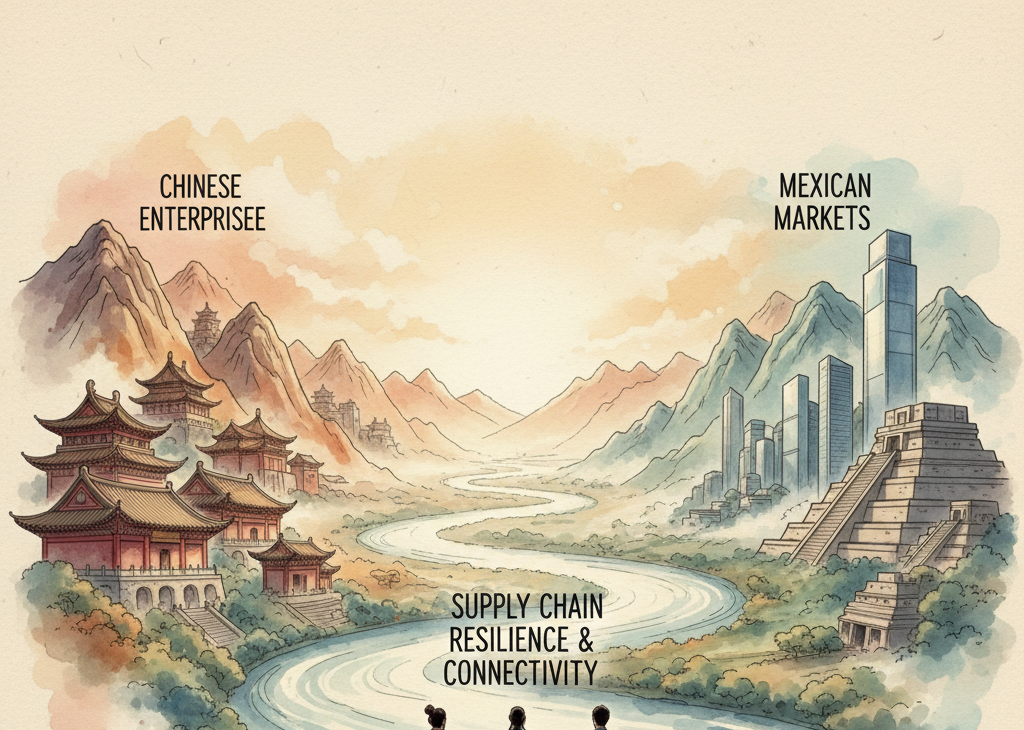
The 2026 USMCA review presents a definitive competitive window for Chinese enterprises to transition from low-cost manufacturing to high-compliance, regionalized production platforms. With U.S. policy signaling a shift toward aggressive rules of origin enforcement, companies that act to audit and localize their supply chains within the next 18 months will capture market share currently held by firms paralyzed by regulatory uncertainty.
For the Chinese enterprise chairman, this is not merely a compliance exercise but a strategic reallocation of capital. The proven success of enterprises that have already integrated regional sourcing indicates that North American market access will be reserved for those who can provide granular traceability. From a Chinese enterprise positioning standpoint, the variables in this review with direct impact on Mexico strategy are regional value content (RVC) and the total elimination of non-compliant Asian inputs.
- 10% – 25%
- Anticipated range for potential unilateral U.S. tariff impositions on automotive sectors — CSIS Policy Analysis
- 100%
- Required traceability threshold for ‘melted and poured’ steel compliance — Automotive Supply Chain Standards
The Automotive Rule of Origin Enforcement: Closing the Backdoor
The 2026 review will prioritize the closure of supply chain loopholes, particularly regarding the triangulation of Asian-origin components. Washington is signaling a demand for rigorous documentation that proves components are not just assembled in Mexico but are fundamentally North American in origin. For Chinese manufacturers, this necessitates an immediate shift in procurement strategy.
Successful enterprises have already begun replacing non-compliant Tier 2 and Tier 3 suppliers with local partners capable of meeting regional content mandates. This shift is not merely defensive; it is a prerequisite for maintaining duty-free status. As noted in the analysis of production system integrity, fundamental modifications to manufacturing systems are no longer optional.
Geopolitical Risk Variable: Trilateral Navigation Pathway
The risk of unilateral tariff imposition—specifically under Section 232 or broader trade-enforcement mandates—requires a governance pathway that prioritizes transparency. By formalizing supply chain maps and participating in proactive customs pre-clearance programs, enterprises can insulate themselves from the political volatility that often precedes review cycles.
Traceability as Governance: The New Competitive Moat
The administrative burden of certifying origin has become the primary barrier to entry for mid-sized players. Tier 1 suppliers are now requiring comprehensive supply chain maps from their sub-tier network to satisfy U.S. Customs and Border Protection. Enterprises that treat this as a core governance function rather than a compliance annoyance are securing their positions as preferred suppliers.
As explored in the research on steel origin compliance, surface-level packaging standards are insufficient. Governance frameworks must now account for the full lifecycle of raw materials, ensuring that every input meets the strict definitions established by the USMCA secretariat.
Compliance Risk: Governance Framework That Bounds It
The risk of blanket border inspections or slowdowns creates an operational bottleneck that can stall production lines. To mitigate this, firms must implement a digital traceability architecture that provides real-time proof of origin. This proactive strategy allows for rapid verification during audits, effectively de-risking the supply chain against the potential for administrative delays.
Operational Audit Protocol: Systematic Verification of Labor and Environment
To navigate the 2026 review, enterprises must conduct systematic audits of their operations across four critical dimensions: labor value content (LVC), environmental compliance, local sourcing, and raw material origin. This level of rigor is what distinguishes the market leaders from those vulnerable to trade policy shifts.
As detailed in the strategic border operations framework, the highest compliance scores are achieved by firms that treat environmental and labor protocols as integrated components of their trade strategy. This approach not only satisfies regulators but also builds resilience against the protectionist tendencies of the sunset clause review.
Execution Risk: De-Risked Implementation Model with Timeline
The execution risk lies in the lag between procurement changes and regulatory verification. Enterprises should implement a 12-month transition plan to audit all sub-suppliers, replacing those who cannot meet the new certification standards. This model replaces reactive damage control with a proactive governance structure that ensures long-term operational continuity.
Your Mexico Market Position: Architecting Long-Term Control Through Turnkey Execution
The window for securing your Mexico market position is narrowing as the 2026 review approaches. Firms that prioritize supply chain transparency now will find themselves in a dominant position when competitors face the inevitable disruption of non-compliance. First-mover advantage in this context is defined by the speed at which an enterprise can validate its entire regional value chain.
For enterprises currently evaluating entry, the governance decisions made today—specifically regarding partner selection and raw material sourcing—will determine your competitive durability for the next decade. Do not view the 2026 review as a barrier, but as a filter that will remove less-prepared competitors from the North American market.
For those already present, the transition toward a fully localized production system is the only path to sustained duty-free access. Our quarterly reports provide in-depth analysis of specific investment opportunities. Contact us for customized strategic insight.
The 2026 USMCA review serves as a catalyst for North American industrial consolidation; enterprises that align their supply chains with regional content mandates today will secure a permanent competitive advantage, while those who hesitate risk losing access to the world’s most significant consumer market as the window for non-compliant triangulation closes.
面对2026年《美墨加协定》(USMCA)的审查,中国企业必须将其视为从低成本制造向区域深度整合转型的关键窗口。长远战略布局的核心在于建立严密的供应链可追溯性,以确保在合规性筛选中占据主动。互利共赢的本地化策略不仅是应对关税风险的防御手段,更是通过整合本地劳动力与工程价值,确立在北美市场长期竞争优势的必由之路。忽视这一合规性升级的代价,将是错失进入北美核心市场的准入资格。
Alex Moreau-Wang, a leading authority on Mexico-China bilateral strategic cooperation and geoeconomics
